


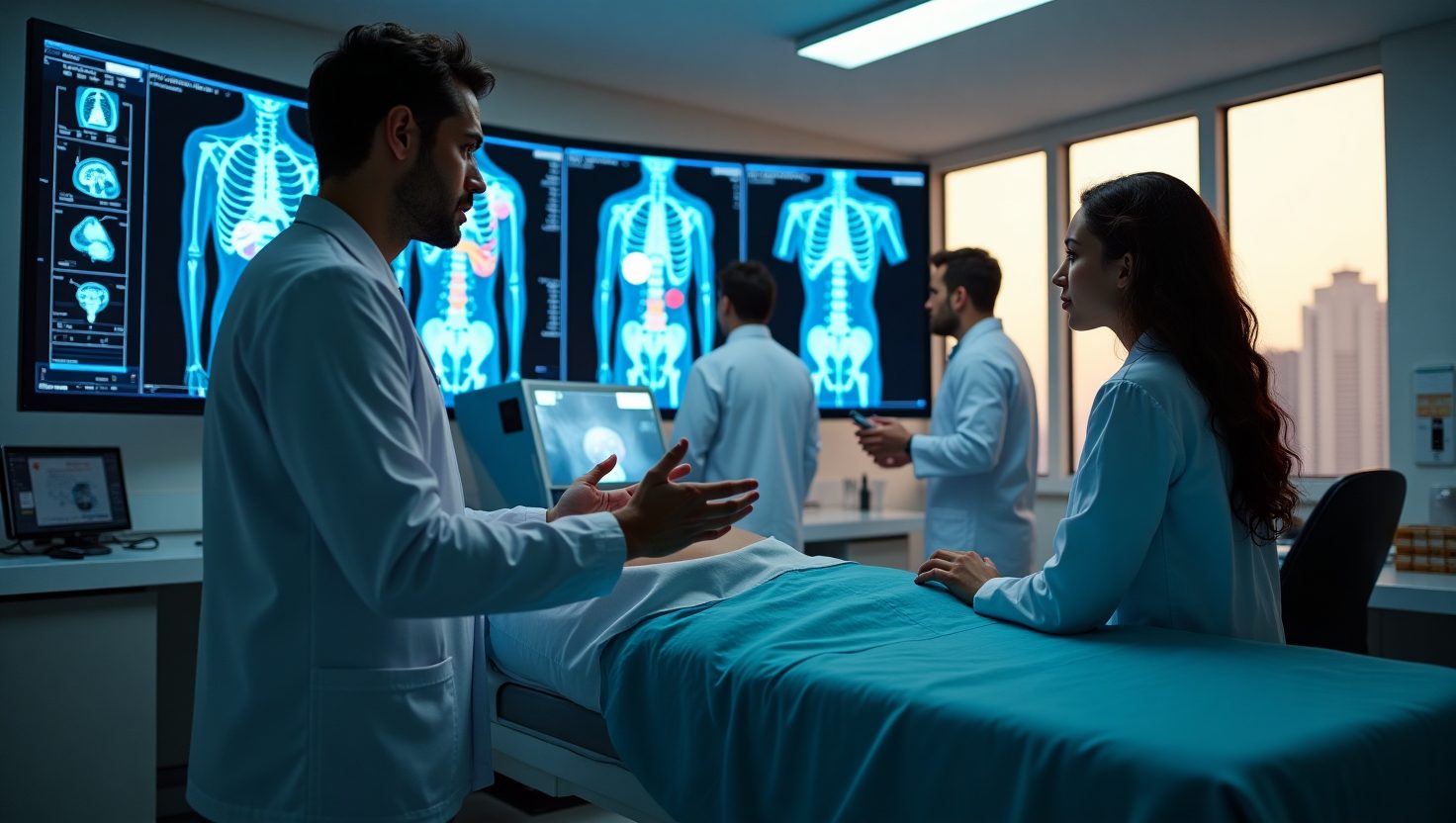
AI-Powered Precision: The Future of Biomedical Segmentation Awaits
—
When Pixels Become Patients: Why Segmentation Matters
Imagine trying to colour a detailed anatomical sketch with a blunt crayon. That’s roughly what manual biomedical segmentation looked like before AI entered the picture. Clinicians would spend hours tracing cell boundaries or tumour margins in medical scans – work that’s both tedious and prone to human error.
This process of biomedical segmentation – separating relevant anatomical structures in images – forms the backbone of modern diagnostics and treatment planning. From measuring cancer progression to mapping brain regions, its accuracy directly impacts patient outcomes. But as MIT researcher Hallee Wong notes: “Many scientists might only have time to segment a few images per day… Our hope is that this system will enable new science.”
Enter AI biomedical segmentation – where deep learning meets diagnostic precision.
—
From Microscopes to Machine Learning: A Revolution in Progress
The Dark Ages of Manual Segmentation
Until recently, segmentation resembled a particularly cruel form of digital embroidery:
– Pathologists clicking through 3D MRI slices layer by layer
– Radiologists spending 30+ minutes per scan outlining organs
– Clinical trials delayed by inconsistent annotations between researchers
The limitations weren’t just about time. Human eyes fatigue. Fingers slip. Two experts might disagree on where a tumour boundary truly lies.
The AI Inflection Point
Three technological shifts changed the game:
1. Computational power: GPUs capable of processing 3D medical images in seconds
2. Algorithm advances: Vision transformers outperforming traditional CNNs in edge detection
3. Data democratisation: Shared repositories like the NIH’s Imaging Data Commons
The result? Systems that can segment a CT scan faster than you can brew a cup of tea.
—
MultiverSeg: MIT’s Context-Aware Game Changer
At the forefront is MultiverSeg, developed by MIT CSAIL in collaboration with Harvard Medical School and Massachusetts General Hospital. This isn’t just another segmentation tool – it’s what happens when machines learn to think like seasoned radiologists.
How It Works (Without the Jargon)
Think of it as a medical student that never sleeps:
1. First case: You guide it with a few clicks/scribbles (“This blob is the liver”)
2. Fifth case: It starts recognising similar organ patterns autonomously
3. Ninth case: Achieves 90% accuracy with just two clicks per image
The secret sauce? A context set that grows smarter with each segmentation. By the tenth patient scan, the system essentially says: “I’ve seen this movie before – let me handle the boring parts.”
—
Why Hospitals Are Paying Attention
The Efficiency Equation
Clinical trials live or die by two factors: speed and consistency. MultiverSeg impacts both:
– 66% fewer scribbles needed compared to previous tools
– 75% reduction in clicks for equivalent accuracy
– Zero-input segmentation achievable after ~10 cases
For a Phase III drug trial requiring 10,000 image segmentations, this could shave months off timelines – and millions off budgets.
Accuracy That Changes Outcomes
In radiation therapy planning, a 2mm segmentation error can mean the difference between nuking a tumour and frying healthy tissue. Early tests show AI tools reducing inter-observer variability (those pesky human disagreements) by up to 40%.
—
The Road Ahead: From Labs to Clinics
The Autonomous Future
Current systems still need occasional human guidance. But the trajectory points toward:
– Self-improving algorithms: Models that update with each new case
– Cross-institutional learning: Secure data sharing between hospitals
– Real-time segmentation: Instant analysis during surgeries
MIT’s team hints at a near future where segmentation becomes like autocomplete – starting with a few letters (clicks) before accurately guessing the full word (anatomy).
The Collaboration Imperative
Breakthroughs like MultiverSeg didn’t happen in silos:
– MIT provided the machine learning muscle
– Harvard Medical School contributed clinical expertise
– Massachusetts General Hospital tested real-world viability
This blueprint – technologists + clinicians + implementers – will define the next wave of medical AI.
—
The Bigger Picture: AI as Co-Pilot, Not Replacement
Skeptics often frame AI in healthcare as either saviour or job thief. The reality’s more nuanced. Tools like MultiverSeg:
– Empower time-strapped clinicians to focus on diagnosis over drudgery
– Democratise precision medicine for resource-limited hospitals
– Accelerate research that could unlock treatments for Alzheimer’s, rare cancers, etc.
As Wong’s team demonstrated, even cutting-edge AI currently needs human collaboration. But the balance is shifting – and that’s precisely what makes this moment transformative.
—
The Burning Question: If AI can segment a scan in seconds, what should clinicians do with their reclaimed hours? For overworked NHS radiologists facing 18% staff shortages, this isn’t hypothetical. The answer might lie not in doing less, but in discovering more – using AI-generated precision to ask better questions about the images (and patients) before them.
Inspired by MIT/Harvard research published in Nature Communications. Explore the original study here.
—
Food for Thought: How might self-learning segmentation tools reshape personalised medicine? Could your local hospital’s cancer outcomes improve faster by adopting such systems? Let’s discuss in the comments.

