


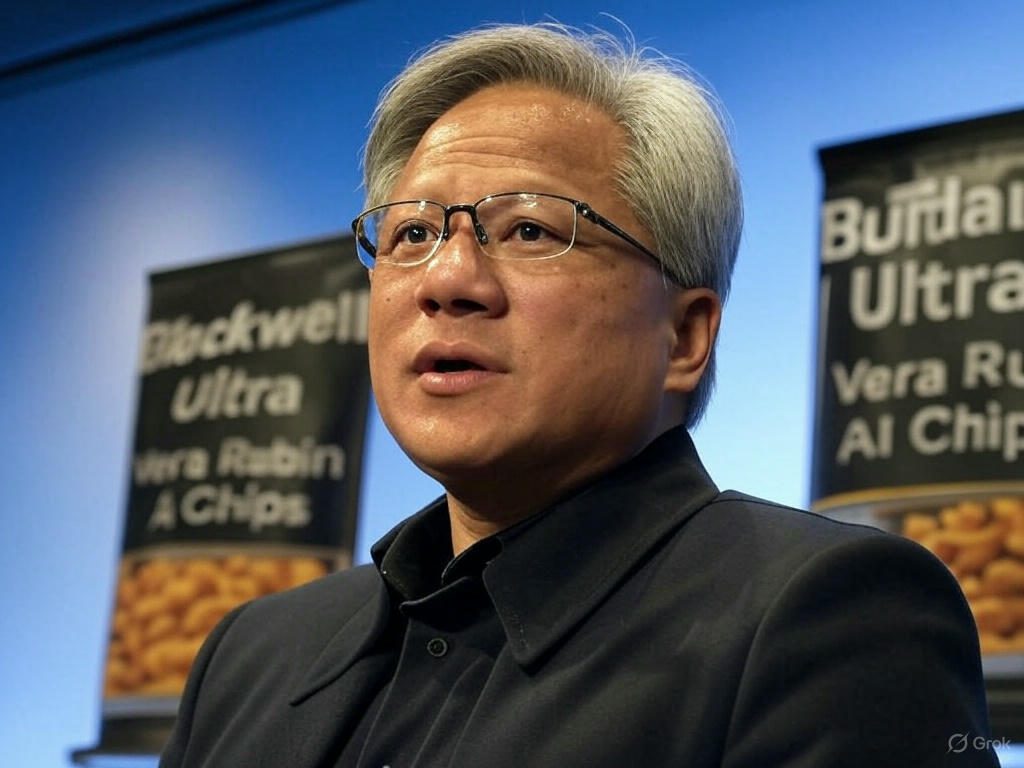
Right, let’s get down to brass tacks, shall we? Jensen Huang and Nvidia just dropped a bombshell at the GTC Conference, and it’s got the whole tech world in a proper kerfuffle. Forget incremental upgrades; we’re talking about a seismic shift, a tectonic plate movement in the AI landscape. They’ve unveiled something called the Nvidia Blackwell Chip, and blimey, it looks like it’s about to crank up the AI Industrial Revolution to eleven.
The Blackwell Revelation: Is This the Future of AI?
So, what exactly is this Nvidia Blackwell Chip everyone’s rabbiting on about? Well, in typical Nvidia fashion, they haven’t just tweaked an existing design; they’ve gone back to the drawing board and built something utterly monstrous. Imagine taking two of their already beefy chips, stitching them together with some sort of technological wizardry, and then cranking up the performance dial until it’s practically glowing. That’s Blackwell in a nutshell.
Double the Trouble, Double the Power
We’re talking about a chip that boasts a staggering 208 billion transistors. Let that number sink in for a moment. That’s billions, with a ‘b’. To put it in perspective, it’s like comparing a pocket calculator from the 70s to the most powerful supercomputer today. The Blackwell architecture significantly increases the density and performance compared to Nvidia’s previous top-dog, Hopper. And what does all this raw power translate to? Faster, more efficient, and frankly, more capable AI Models.
DGX GB200: The Beast Unleashed
Of course, a chip this powerful needs a proper home, doesn’t it? Enter the DGX GB200. Think of it as the ultimate supercomputer in a box, powered by not one, but eight Blackwell GPUs and paired with Nvidia’s Grace CPUs. This isn’t just for bragging rights down at the pub; the DGX GB200 is designed to tackle the most demanding AI workloads imaginable. We’re talking about training colossal AI Models with trillions upon trillions of parameters – the kind of models that are pushing the boundaries of what AI can actually do.
Nvidia GTC Conference Announcements: More Than Just Chips
The Nvidia GTC Conference wasn’t just a coming-out party for the Nvidia Blackwell Chip; it was a whole shebang showcasing Nvidia’s vision for the future of, well, everything. Jensen Huang, Nvidia’s charismatic CEO, took to the stage with his trademark leather jacket and infectious enthusiasm, laying out a future where AI is woven into the very fabric of our digital and physical lives. It wasn’t just about faster chips; it was about a complete ecosystem, a platform for the next wave of innovation.
Networking Gets a Nitro Boost
Now, all this processing power is no good if the data can’t keep up, right? Nvidia’s got that covered too. They’ve unveiled new networking technologies, like NVLink Switch and Quantum-X800 InfiniBand, designed to move data around these massive AI systems at ludicrous speeds. Think of it as widening the motorway to cope with rush hour traffic – but instead of cars, it’s petabytes of data hurtling along at the speed of light. This is crucial because training these massive AI Models requires feeding them colossal datasets, and bottlenecks are simply not an option.
Software is Still King (or Queen)
And let’s not forget the software side of things. Nvidia isn’t just a hardware company anymore; they’re building a complete software stack to go with their silicon. From CUDA to their ever-expanding library of AI frameworks and tools, they’re making it easier and easier for developers to harness the power of their chips. This is where the real magic happens, turning raw processing power into tangible Benefits of Nvidia Blackwell AI chip. It’s like giving artists better brushes and paints – suddenly, they can create masterpieces we never thought possible.
How Does Nvidia Blackwell Chip Improve AI? It’s All About Scale
So, how does Nvidia Blackwell chip improve AI? The answer, in short, is scale. Bigger models, more complex simulations, faster training times – Blackwell is designed to unlock a new era of AI capabilities. Think about areas like drug discovery, climate modelling, and robotics. These fields are all incredibly data-hungry and computationally intensive. Blackwell isn’t just about making things a bit faster; it’s about making entirely new classes of problems solvable.
Tackling the Trillion-Parameter Beast
The current generation of large language models, the ones powering your chatbots and AI assistants, are already mind-bogglingly complex. But they’re just the tip of the iceberg. The next generation of AI Models is heading towards trillions of parameters, and beyond. Training these behemoths is a herculean task, requiring vast amounts of computing power and energy. The Benefits of Nvidia Blackwell AI chip include dramatically reducing the time and cost it takes to train these massive models, making them more practical and accessible.
Real-World Impact: Beyond the Hype
Let’s be honest, tech announcements can often feel a bit… well, hyped. But the Nvidia Blackwell Chip feels different. This isn’t just about incremental improvements; it’s about enabling a step-change in what AI can achieve. Consider scientific research. Imagine simulating complex biological systems to accelerate drug discovery, or creating incredibly detailed climate models to better understand and combat climate change. These are the kinds of problems that Blackwell is designed to tackle. It’s about moving beyond the theoretical and making a real-world impact.
What is Nvidia Blackwell Chip? Deconstructing the Tech
Right, let’s get a bit more technical for those of you who like to peek under the bonnet. What is Nvidia Blackwell Chip? At its core, it’s a marvel of engineering. Built by stitching together two reticle-limited GPUs into a single, unified chip, Blackwell leverages a custom chip-to-chip interconnect. This allows the two GPUs to function as a single, massive processor, sharing memory and resources seamlessly. It’s like having two brains working in perfect sync, rather than two separate brains trying to cooperate.
Confidential Computing and Security
In today’s world, security is paramount, especially when dealing with sensitive data. Blackwell incorporates advanced confidential computing features, using hardware-based encryption to protect AI Models and data while they are being processed. This is crucial for industries like healthcare and finance, where data privacy and security are non-negotiable. It’s about building trust in AI, ensuring that these powerful technologies are used responsibly and securely.
Energy Efficiency: Powering the Future Responsibly
All this power could come at a hefty energy cost, but Nvidia is also emphasizing efficiency. Blackwell is designed to deliver significantly better performance per watt compared to previous generations. This is not just about being green; it’s also about economics. Running these massive AI systems consumes a lot of electricity, and reducing power consumption directly translates to lower operating costs. In a world increasingly concerned about sustainability, energy efficiency is no longer a nice-to-have; it’s a necessity.
Nvidia Blackwell Chip Release Date: When Can We Get Our Hands On It?
The burning question, of course, is Nvidia Blackwell chip release date. While Nvidia hasn’t given a precise date, they’ve indicated that Blackwell-based products, including the DGX GB200 systems, are expected to become available later this year. However, don’t expect to pop down to your local computer shop and pick one up. These are enterprise-grade systems, designed for large corporations, research institutions, and cloud providers. The initial rollout will likely be to key partners and early adopters, with wider availability following later.
The Race is On: Competition and the AI Landscape
Nvidia isn’t the only player in the Artificial Intelligence Chip game, of course. Companies like AMD, Intel, and a host of startups are all vying for a piece of the pie. But with Blackwell, Nvidia has firmly reasserted its dominance in the high-performance AI computing space. The competition is fierce, and that’s ultimately good for innovation. It pushes everyone to raise their game, leading to faster progress and more powerful and accessible AI technologies for everyone.
The AI Industrial Revolution: Are We Ready?
Jensen Huang and Nvidia are betting big on the AI Industrial Revolution. They see AI transforming every industry, from healthcare and finance to manufacturing and entertainment. And they believe that the Nvidia Blackwell Chip is a key enabler of this revolution. Are they right? Well, if the buzz around the GTC Conference is anything to go by, they might just be onto something. This isn’t just about faster computers; it’s about fundamentally changing the way we live, work, and interact with technology.
Beyond the Chip: A Broader Vision
Ultimately, the Nvidia GTC conference announcements weren’t just about a single chip, however groundbreaking it may be. It was about a broader vision for the future, a future where AI is pervasive, powerful, and accessible. Nvidia is positioning itself not just as a chip vendor, but as a platform provider, an ecosystem builder, and a driving force behind this AI Industrial Revolution. Whether they succeed in realizing this ambitious vision remains to be seen, but one thing is clear: the Nvidia Blackwell Chip is a significant leap forward, and it’s going to be fascinating to watch how it shapes the future of AI. What do you reckon? Is Blackwell a game-changer, or just another step on the path? Let me know your thoughts in the comments below.
“`

